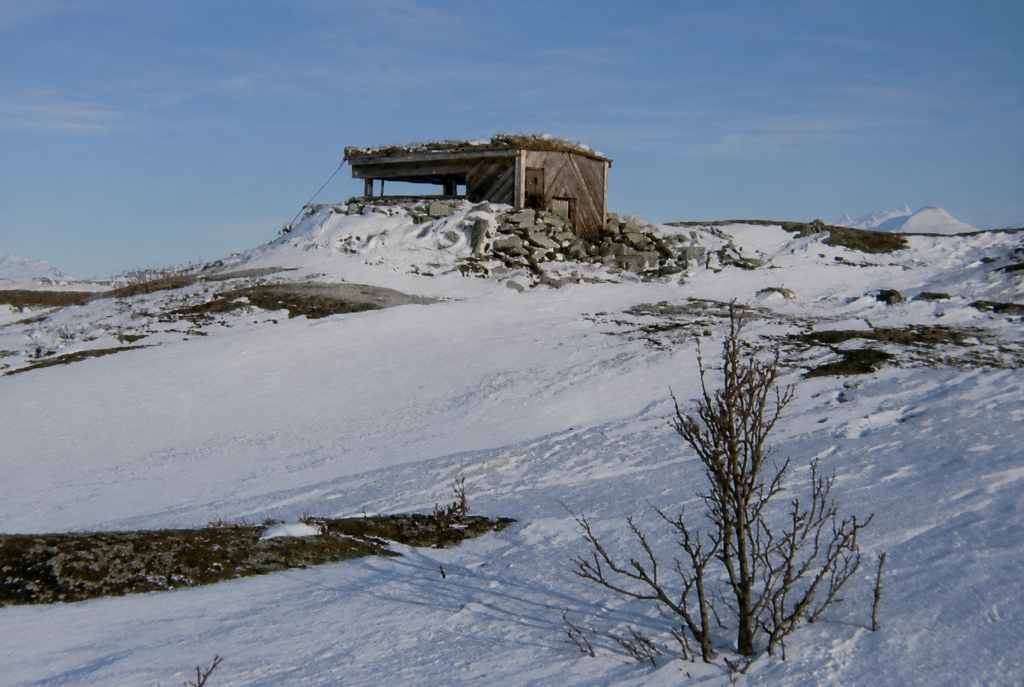
As with most lighthouses, German forces rapidly seized control of Rotvær lighthouse. When the main coastal batteries were pushed forward, surveillance and warning detachments were concurrently advanced and collocated at Stützpunkt Rotvaer in accordance with the Augen der Küste concept.
The principal components at the lighthouse were a naval signal station (Marine Signalstelle, MSS) supporting the harbour master (Hafenkapitän), a naval radio station (Marine Funkstelle), and a FuMO 1–3 Calais air surveillance radar, augmented by a coastal reporting post (Küstenwache) and an air raid warning post (Flugwache).
The adjacent island hosted a searchlight detachment and range-and-bearing observation post (Peilstand) belonging to MAA 3./Lödingen, alongside a naval searchlight battery (Marine Scheinwerfer Batterie) supporting the 7.5 cm anti-aircraft battery MaFla 7./709 Nesodden. The defensive perimeter was heavily fortified with barbed wire, minefields, one 2 cm Flak gun, and one 7.5 cm Pak anti-tank gun.
Post-war, Nes fortress retained a searchlight detachment there and an anti-submarine hydrophone array was planned.